1. Our team will reach out in <30 minutes.
Check your inbox or phone, we’ll tailor your demo to your use case.
2. We build your custom demo
Flowcodes, FlowURLs, and FlowHubs with the data behind the whole platform - so you see exactly what Flowcode unlocks.
3. You go live in days
Our team handles setup. You handle growth.









.webp)











.png)

.png)



.png)


.png)

.png)

%20copy%203.png)




.png)


Back to all articles
How to Measure CTV and TV Ad ROI
August 11, 2026
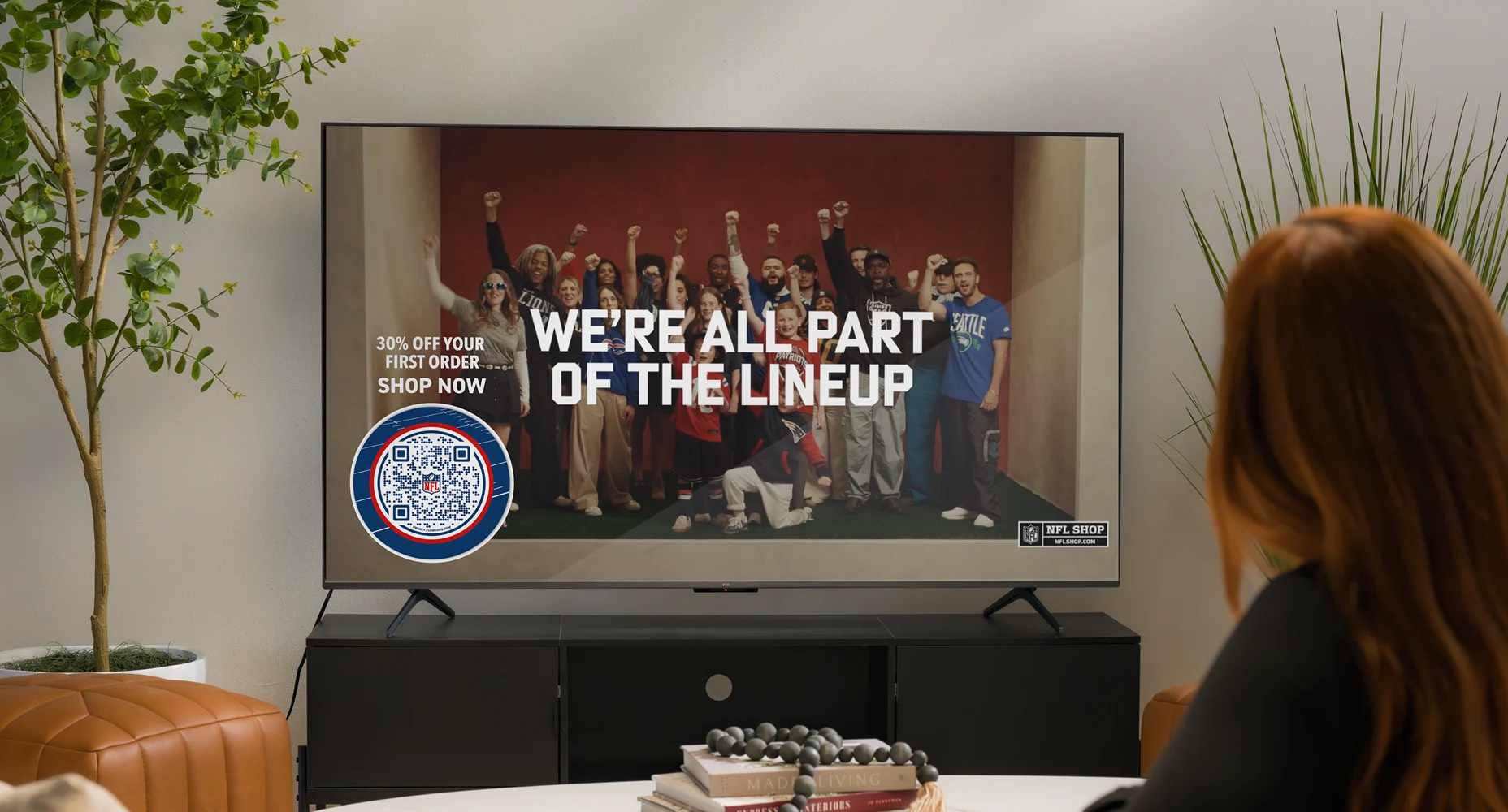
Television still commands the biggest budgets in advertising, and it's still the hardest channel to prove. A viewer sees your ad, buys three days later on a different device, and most measurement stacks record nothing. That's why marketers have leaned on modeled brand-lift studies for years, and why they still can't tell you what a single 30-second spot returned.
What is TV and CTV ad attribution?
TV and CTV ad attribution is the practice of connecting a specific television or connected-TV ad exposure to a downstream action, such as a scan, visit, signup, or purchase, so you can calculate the return on that ad spend. Traditional TV measurement infers impact from audience panels and pre/post surveys. Attribution, by contrast, captures a direct signal from the viewer.
This matters more every year. TV budgets are enormous, scrutiny is rising, and roughly 81% of the economy still happens in the real world, where broadcast reaches people at scale. Over $328B a year flows into real-world marketing, and without attribution, that spend is a black box.
Why is TV ad ROI so hard to measure?
Three structural problems break the measurement chain:
- The cross-device gap. A viewer sees the ad on a TV and converts on a phone or laptop. Cookie-based tracking never sees the TV impression.
- Delayed conversions. Purchases can trail exposure by days, defeating last-click models.
- No built-in response mechanism. A standard spot gives the viewer nothing to do, so there's no signal to measure.
The fix is to give viewers a reason and a way to respond on the spot, then instrument that response. Once a placement carries an offer and a connected code, the response becomes a signal you can count.
How do you measure TV and CTV ad ROI?
There are four proven methods, and most sophisticated advertisers layer several together:
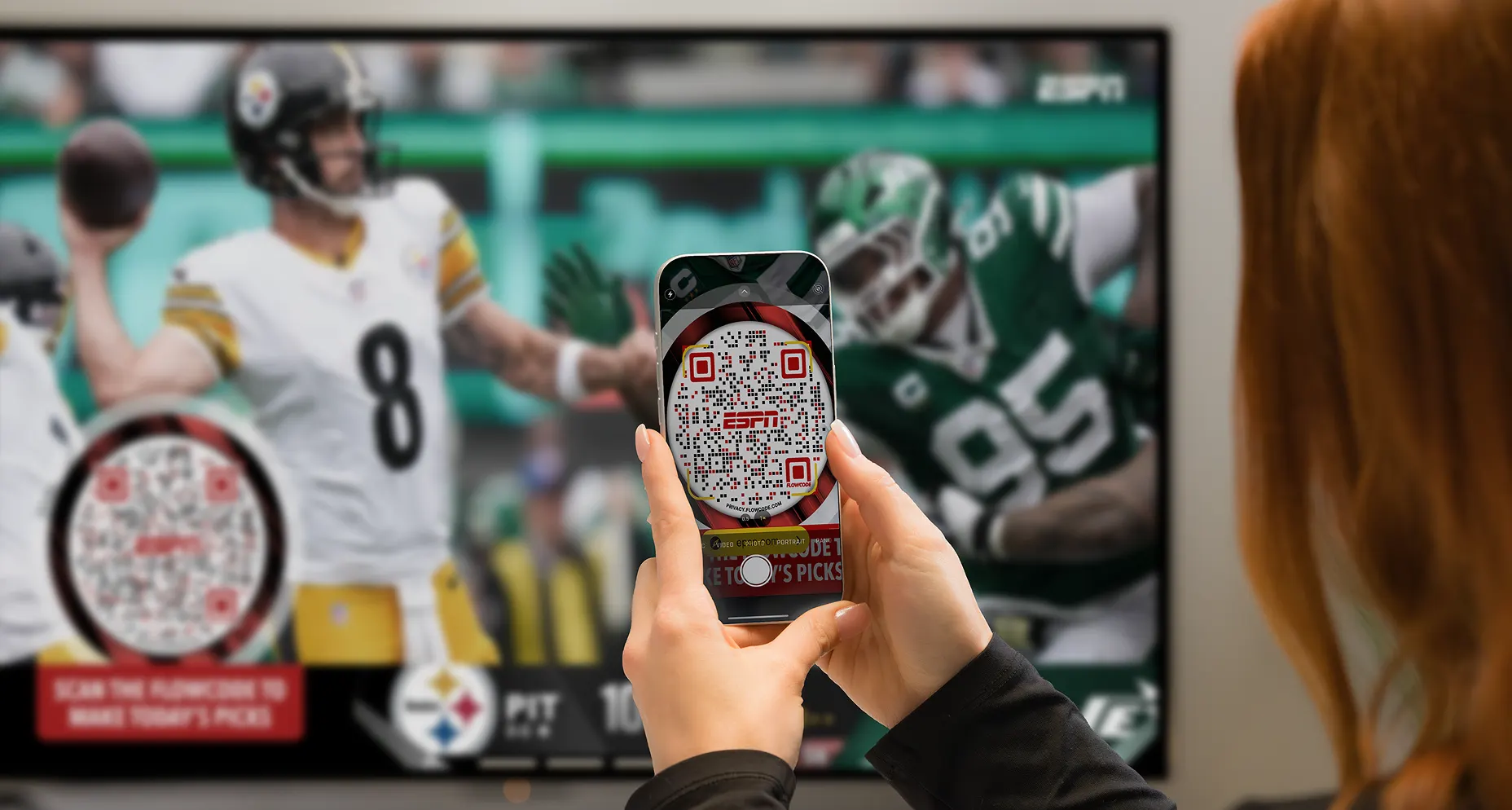
On-screen codes are the workhorse. A dynamic code gives viewers a fast bridge from the couch to a conversion flow - Flowcode's analytics dashboard shows every connection in real time, and because the destination is dynamic, you can swap offers between the East and West Coast feeds without reprinting anything. Pixel tracking is what turns a connection into an ROI figure: by firing on response, you can match that person to a later purchase and feed the audience back into your ad platforms for retargeting.
What metrics should you track?
Track these five, in this order:
- Connection rate. Connections divided by impressions. This is your engagement floor.
- Cost per action (CPA). Media cost divided by measured actions.
- Conversion rate. Actions that completed the goal, such as a purchase, signup, or add-to-cart.
- Revenue per spot or ROAS. Attributed revenue against spend.
- Time-to-conversion. The lag between exposure and action, which tells you how long to hold your attribution window open.
A step-by-step framework
- Define the action. Decide what a "conversion" is before you buy media.
- Add a measurable call to action to the creative. Place a dynamic code or shoppable unit on screen long enough to connect (aim for 5+ seconds).
- Route connections to a purpose-built flow. Send viewers to a fast mobile experience, not a homepage.
- Fire an offline pixel on connection. Capture the event so you can match back to revenue and build retargeting audiences.
- Set your attribution window. Often 24 hours to 7 days for broadcast.
- Reconcile to CRM and ad platforms. Match connections to buyers, then calculate CPA, conversion rate, and revenue per spot.
- Optimize between airings. Swap offers, creative, or flows.
Frequently asked questions
Can you actually measure ROI on a TV ad?
Yes. By adding a connectable call to action and firing an offline pixel on response, you can tie a specific spot to specific conversions and revenue, as NFL Shop did in driving $25,000 from a single broadcast spot.
What's the difference between TV and CTV attribution?
CTV is delivered over the internet, so it supports interactive, one-click ad units and device-level exposure data. Linear TV relies more on on-screen codes and unique URLs. Both can feed the same match-back model. See how this plays out on Peacock's Love Island, where connected TV moments drive real-time engagement.
What's a good connection rate for a TV ad?
It varies by category and offer. A strong incentive and a clear on-screen call to action move the rate up.