1. Our team will reach out in <30 minutes.
Check your inbox or phone, we’ll tailor your demo to your use case.
2. We build your custom demo
Flowcodes, FlowURLs, and FlowHubs with the data behind the whole platform - so you see exactly what Flowcode unlocks.
3. You go live in days
Our team handles setup. You handle growth.









.webp)










.png)

.png)
.png)

.png)

.png)

%20copy%203.png)

.png)

Back to all articles
How to Use Discount Offers for Real-Time TV and Broadcast Ad Attribution
June 23, 2026
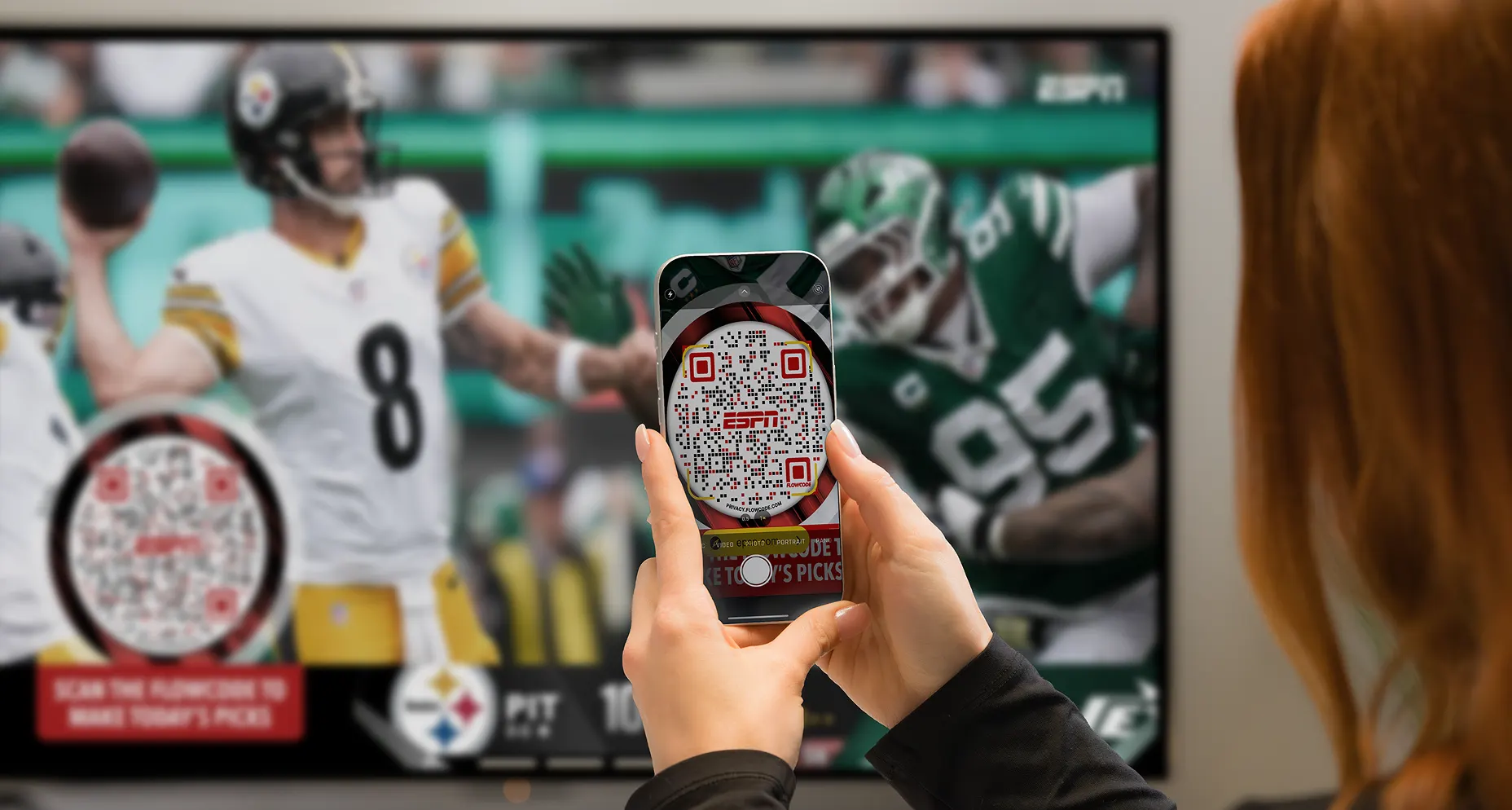
A live discount tied to a trackable Flowcode turned a single broadcast spot into $8,000 in revenue and an 88% conversion rate in 30 minutes, proving the offer itself can be the measurement instrument.
Broadcast ad attribution works best when the ad itself asks for a decision, not just attention. The clearest proof: the Pittsburgh Penguins turned a single on-air discount into $8,000 in merchandise revenue in 30 minutes, at an 88% conversion rate, by tying a real offer to a trackable Flowcode. Media buyers already run promotions. What's new is treating the offer itself as the measurement instrument, not just a nice-to-have incentive layered on top of the media.
The clearest example: a live discount, not a coupon
The Pittsburgh Penguins put a discount Flowcode on screen during a broadcast, reinforced by a live read from the announcers. The result: $8,000 in merchandise revenue within 30 minutes, at an 88% conversion rate. That's not a brand awareness metric, it's a P&L line item with a timestamp.
The mechanic is simple and repeatable. Pair a real discount with a branded, trackable Flowcode, put it on screen long enough for a viewer to find their phone and act, and let the redemption itself be the proof. No survey, no lift study, no thirty-day attribution window. The revenue lands while the segment is still airing.
Why offers outperform generic awareness placements
An offer changes the psychology of the moment. A generic "visit our website" prompt asks for curiosity. A discount asks for a decision, and decisions are what attribution systems can actually count. Three things make offer-based placements measurable in a way plain brand activations aren't:
- Urgency compresses the response window. A time-bound discount concentrates connections into the minutes the Flowcode is on screen, which is exactly the window Flowcode Pixel needs to tie the action back to that placement.
- The redemption is the KPI. You don't have to infer intent from a click. A redeemed discount Flowcode is unambiguous revenue, attributable to the minute it aired.
- It's repeatable across formats. The same logic works on a jumbotron, an in-episode streaming overlay, or a wallet offer inside a fan hub. The mechanic doesn't care what screen it's on.
How to run this on your next broadcast
- Pick a real discount, not a token one. The Penguins' offer was steep enough to move people to act inside a 30-minute window.
- Reinforce it live. An announcer callout or on-screen graphic buys the extra few seconds a viewer needs to find their phone.
- Route straight to checkout. The offer should land on a purchase flow, not a homepage. Every extra tap costs conversions.
- Fire a pixel on redemption. That's what lets you report revenue against a specific placement instead of a vague engagement number.
Frequently asked questions
Do offers really measure attribution better than awareness placements? Yes. A redemption is a completed transaction, not an inferred signal, so it ties revenue directly to the moment a placement aired, as the Pittsburgh Penguins showed with $8,000 in merchandise revenue in 30 minutes at an 88% conversion rate.
Does discount-based attribution only work on live broadcast? No. The same mechanic works on a jumbotron, a streaming overlay, or a wallet offer inside a fan hub, since the redemption is what makes it measurable, not the screen it appears on.
What makes an offer strong enough to drive this kind of result? The discount has to be steep enough, and visible long enough, to move someone to act inside a short window rather than think it over later.