1. Our team will reach out in <30 minutes.
Check your inbox or phone, we’ll tailor your demo to your use case.
2. We build your custom demo
Flowcodes, FlowURLs, and FlowHubs with the data behind the whole platform - so you see exactly what Flowcode unlocks.
3. You go live in days
Our team handles setup. You handle growth.









.webp)




















.png)

.png)




.png)


.png)

.png)

%20copy%203.png)




.png)





Back to all articles
The Enterprise Activation Playbook: A Timeline for Large-Scale Campaign Planning
September 28, 2026
A single broadcast spot can send more traffic in one second than most campaigns see in months, and the brands that never have a bad moment on stage got there by treating infrastructure readiness, CSM planning, and post-campaign reporting as one continuous discipline, not three separate afterthoughts.
The difference between a flawless activation and a broken one usually comes down to one thing: whether the infrastructure was ready before that moment hit. Here's what that actually takes, from the planning that gets you there to the reporting that proves it worked.
The Technical Reality of a Traffic Spike
Picture a 30-second commercial airing during a broadcast with over a hundred million viewers. The code on screen needs to take every one of those viewers from a physical touchpoint to a digital destination, instantly. There's no ramp-up. No warning window. Just zero to thousands of requests in a single second.
From a systems perspective, that pattern looks identical to a denial-of-service attack, the kind of traffic surge hackers use to take a website offline. The difference is that this traffic is completely legitimate, and unforgiving of downtime.
Handling it reliably comes down to a few core disciplines:
- Scale ahead of load, never in response to it. By the time a spike is visible, it's too late to react to it. Infrastructure has to be provisioned for peak volume before the moment airs.
- Distribute globally. Serving content from multiple data centers and modern edge caches means no single point of infrastructure carries the full weight of the moment.
- Optimize the full request path. Every service between the initial connection and the analytics store gets profiled and tuned, down to microseconds.
- Load test past the platform's real limit. The goal isn't passing a test; it's reaching the point where the testing tools are the bottleneck, not the system itself.
And it doesn't stop at uptime. Enterprise marketers care just as much about clean reporting after the campaign as they do about the connection holding up during it, so protecting data integrity under load, with backup pipelines ready if real-time processing gets overloaded, is treated with the same rigor as the redirect itself.
“We do the hard work of testing, scaling, and optimizing weeks or even months ahead. So by the night of, we're not nervous; we're curious. Everyone's watching the dashboards, waiting to see the spike come in and our systems respond in real time. It's one of my favorite parts of the job: watching all that prep pay off live.”
- Jessica Bridges, VP of engineering at Flowcode

Why The Work Happens Before the Moment Airs
None of the work above happens the week of, and that's by design. Your biggest moment only gets one shot: there's no "we'll fix it live" when a single spot can drive tens of thousands of connections in seconds, and there's no undoing the downtime once it airs. That's why a major activation gets scoped with your Customer Success Manager well ahead of air date, covering expected volume, timing, and technical requirements, so the moment is proven to hold before it goes live.
The failure pattern we see most often isn't technical; it's sequencing. Brands lock creative and media spend for a big moment first, then think about the connection layer last, once there's no runway left to prepare properly, and no time left to catch a problem before it's live in front of an audience.
Early planning isn't red tape. It's what lets every viewer who connects land on a fast, personalized experience that's contextualized to what they just saw, instead of a page that stalls or one that doesn't reflect the moment that brought them there.
What Early Planning With Your CSM Looks Like
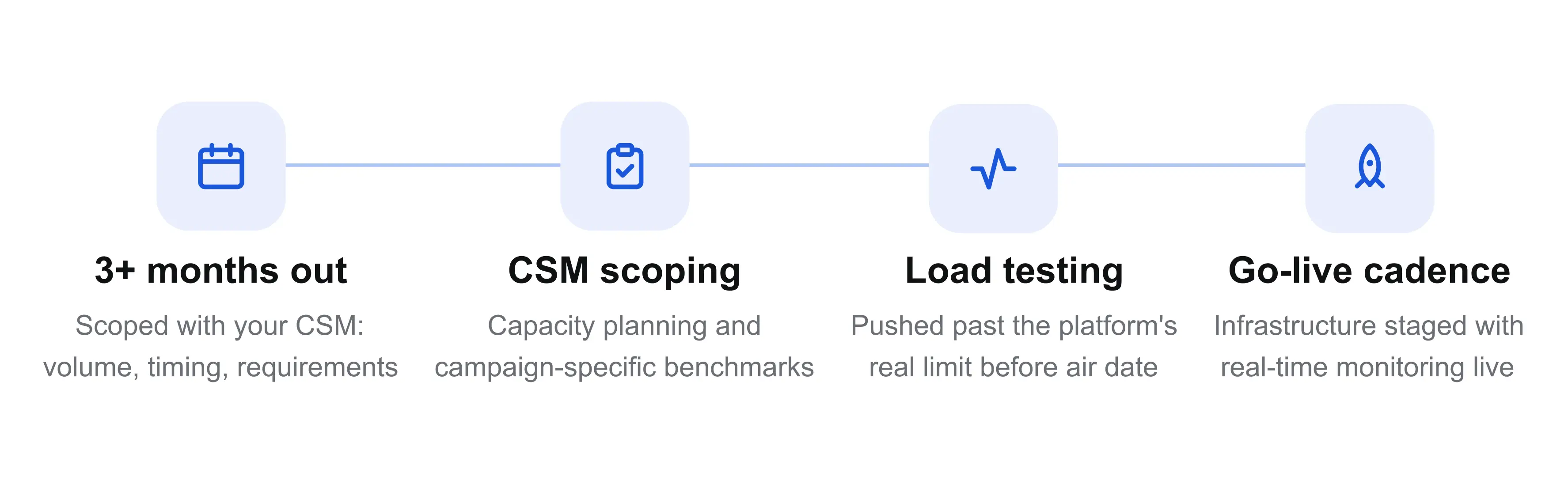
Working ahead of a major activation with your CSM typically covers:
- Capacity planning based on expected audience size and traffic pattern
- Load testing tailored to your specific campaign, not a generic benchmark
- Coordination on go-live timing, so infrastructure is staged exactly when it needs to be
- Real-time monitoring during the activation window, with a team watching the moment as it happens
“Flowcode has helped us shape fan engagement opportunities across in-game, broadcast, and marketing campaigns with valuable insights into overall performance and trends.”
- Kristen Santero, Vice President, Digital Marketing & Fan Development, Vegas Golden Knights
The Same Rigor Applies After the Moment Airs
Uptime during the spike is only half the job. The same platform that holds up when thousands of people connect in seconds is built to hand teams something to act on once the moment ends.
Two-way syncing keeps your CRM and Flowcode in sync automatically: contacts flow in from HubSpot, Salesforce, Marketo, or a CSV, and engagement data flows back out the moment someone connects, so a known contact becomes a recognized FlowID instead of a disconnected record. Custom Dashboards let teams build their own analytics views at the org, workspace, or campaign level, without waiting on a technical resource to pull a custom report. And Scheduled Reports deliver performance data straight to stakeholders' inboxes on a set cadence, including people who never log into the platform at all.
None of this is a bolt-on. It's the same reporting discipline mentioned earlier, built to hold up on the other side of the spike, not just during it.
The Earliest Conversation Is the Cheapest One
The brands that never have a bad moment on the world's biggest stages aren't lucky. They built on infrastructure that's already proven at enterprise scale, for exactly this kind of moment, before it ever airs.
If a major activation is on your roadmap, book a meeting with our team, or reach out to your CSM if you're already a client.